Unique Monthly Visitors: Definition, Measurement and Reporting
Learn what unique monthly visitors mean, how analytics tools count them and which reporting mistakes distort website traffic data.
Zunnun Ahmed · Published · 10 min read
Unique monthly visitors measure monthly website reach by counting each recognized visitor once inside a reporting period. This guide explains the definition, deduplication method, sessions and pageviews comparison, GA4 reporting, competitor estimates, tool discrepancies, segmentation, business use and reporting mistakes that distort website traffic analysis.
What are unique monthly visitors for websites?
Table of Contents
- How are unique monthly visitors counted?
- How are unique monthly visitors different from sessions?
- How do you find monthly unique visitors in GA4?
- How do you estimate unique monthly visitors for competitor websites?
- Why do unique monthly visitor counts differ between tools?
- How do you segment monthly unique visitors?
- Why do unique monthly visitors matter for business decisions?
- What are the common mistakes when reporting unique monthly visitors?
Unique monthly visitors are distinct recognized visitors who access a website during one monthly reporting period. The metric counts audience reach, not total visits, page loads or every interaction recorded by an analytics platform.
- Website scope: The count usually applies to a domain, subdomain, site section or selected page group, depending on the report configuration.
- Repeat behavior: A recognized visitor who returns several times during the month still counts once for that month.
- Audience reach: The number helps teams understand how many separate visitors the site reached before quality metrics such as engagement and conversions enter the analysis.
How are unique monthly visitors counted?
Analytics tools count unique monthly visitors by assigning or reading a visitor identifier and deduplicating that identifier inside the selected month. The identifier often comes from a browser cookie, client ID, device ID, login ID or platform-specific visitor profile.
- A visitor loads a page on the website.
- The analytics tag or server-side system reads an existing identifier or creates a new one.
- The platform records sessions, pageviews and events against that identifier.
- The monthly report counts the recognized identifier once during the reporting period.
- Repeat sessions from the same identifier increase session totals, not the monthly unique visitor total.
Example: one recognized visitor who visits on 10 different days during June creates one monthly unique visitor for June. The same activity creates multiple sessions and many pageviews if the visitor loads several pages.
What monthly timeframe rules apply to unique visitor reporting?
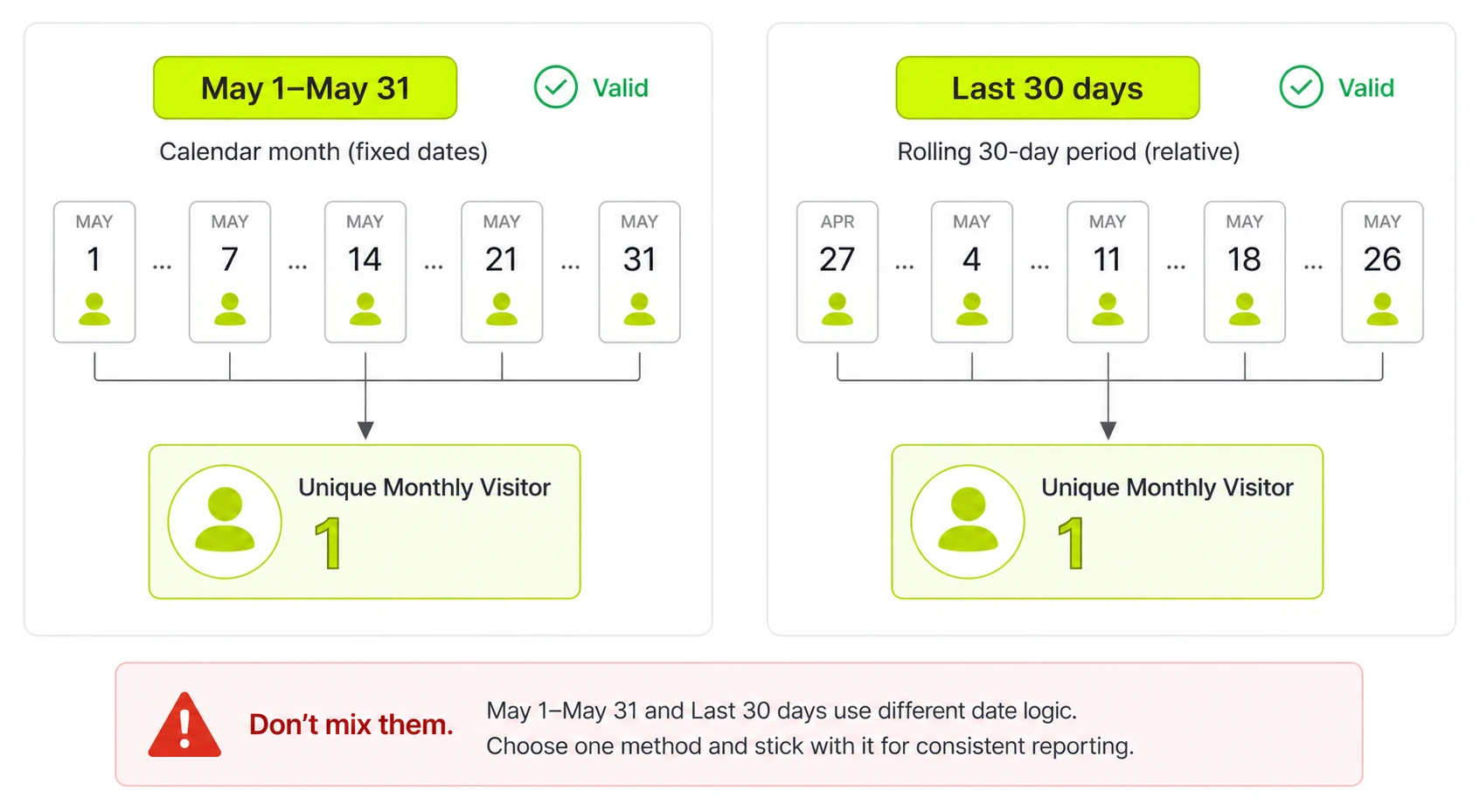
Monthly unique visitors require one consistent calendar month or rolling 30-day range from one analytics source and one time zone. Daily unique visitor counts do not add into a monthly total because the same recognized visitor appears on multiple days inside the month.
How are unique monthly visitors different from sessions?
Unique monthly visitors measure distinct audience reach, while sessions measure separate visits or activity periods. One recognized visitor creates one monthly unique visitor in a month and creates several sessions when that person returns at different times.
|
Metric |
What it counts |
Example |
Best use |
|---|---|---|---|
|
Unique monthly visitors |
Recognized visitors deduplicated during the month |
One person visits five times and counts once |
Measure monthly reach |
|
Sessions |
Separate visit periods from recognized visitors |
One person visits five times and creates five sessions |
Measure visit frequency and acquisition volume |
How are unique monthly visitors different from pageviews?
Pageviews count page loads, while unique monthly visitors count recognized visitors. One visitor who reads six pages creates one monthly unique visitor and six pageviews, so pageviews describe content consumption rather than audience size.
How do new and returning visitors affect monthly unique visitor reporting?
New and returning visitor segments explain whether monthly reach comes from acquisition or repeat audience behavior. A rising new visitor share points to discovery growth, while a stronger returning share points to repeat interest or loyalty.
- New visitors: useful for campaign, SEO and audience acquisition analysis.
- Returning visitors: useful for loyalty, retention and content value analysis.
- Tracking caveat: cookie deletion and changed identifiers turn some returning visitors into apparent new visitors.
How do you find monthly unique visitors in GA4?
GA4 reports monthly visitor reach through user metrics such as Total users and Active users after the report date range is set to the month being analyzed. The exact label depends on the GA4 report, exploration and identity settings.
- Open GA4 and select the target property.
- Set the date range to the calendar month or rolling 30-day period used in the report.
- Open Reports for a quick view or Explorations for a custom table.
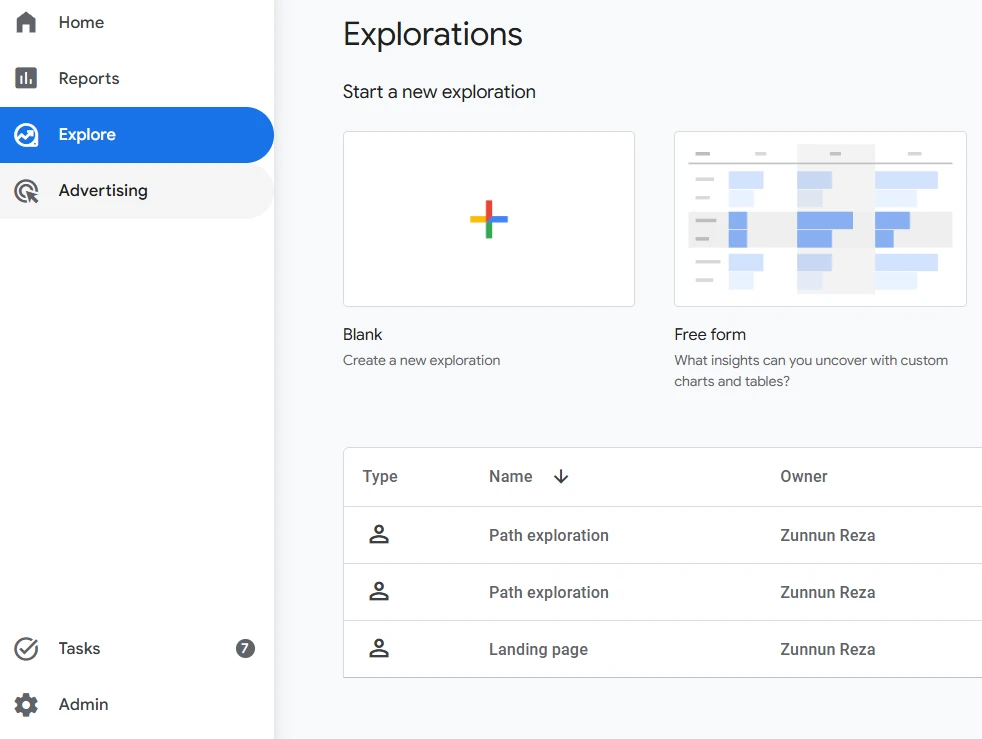
- Use user metrics such as Total users and Active users to represent recognized visitor reach.
- Add a comparison period when the report needs month-over-month trend analysis.
- Keep the same metric definition across every month in the series.
Which tools report or estimate monthly unique visitors?
Monthly unique visitor reporting comes from first-party analytics tools, product analytics systems and third-party traffic intelligence platforms. The source type matters because measured data and estimated data answer different reporting questions.
|
Tool category |
Examples |
Output type |
Best use |
|---|---|---|---|
|
First-party web analytics |
GA4, Matomo, Adobe Analytics |
Measured site data |
Owned website reporting |
|
Product analytics |
Amplitude, Pendo |
Measured user or visitor activity |
App and product usage analysis |
|
Traffic intelligence |
Similarweb and comparable platforms |
Estimated market data |
Competitor and market comparison |
|
Server or CDN analytics |
Log files, CDN dashboards |
Request-level data |
Bot checks and infrastructure-side review |
How do you estimate unique monthly visitors for competitor websites?
Competitor monthly unique visitors are estimates because outside analysts do not have access to the competitor analytics property. A reliable competitor view uses several directional signals instead of one exact number.
- Check traffic intelligence platforms for monthly visitor estimates and trend direction.
- Review publisher media kits, sponsor pages and advertising materials for disclosed audience reach.
- Compare organic visibility, ranking pages and branded search demand for relative traffic scale.
- Use public engagement signals only as supporting context, not as visitor counts.
- Report a range and confidence level instead of one exact figure.
Reporting rule: first-party analytics data answers owned-site performance questions. Third-party estimates answer market comparison questions.
Which tracking identifiers count unique visitors?
Tracking identifiers count unique visitors by linking pageviews, sessions and events to the same recognized browser, device or user profile. Each identifier improves deduplication in one context and creates a limitation in another.
|
Identifier |
How it helps |
Main limitation |
|---|---|---|
|
Cookie or client ID |
Recognizes the same browser across visits |
Cookie deletion, browser limits and consent settings reset identity |
|
User ID |
Connects activity after login |
Anonymous visitors remain separate until identification |
|
Device ID |
Supports app and device-level measurement |
One person using several devices appears several times |
|
IP and user-agent fallback |
Provides limited recognition without cookies |
Shared networks and changing IP addresses reduce accuracy |
|
Identity stitching |
Combines identifiers into one profile |
Depends on platform rules, consent and login coverage |
Why do unique monthly visitor counts differ between tools?
Unique monthly visitor counts differ between tools because each platform uses its own definition, identifier method, filtering rules and estimation model. A discrepancy signals a measurement difference first, not a reporting failure by default.
- Metric definition: one tool reports users, another reports visitors, another reports estimated monthly uniques.
- Identity method: cookies, client IDs, user IDs and device IDs deduplicate people differently.
- Consent and privacy: rejected cookies, tracking prevention and private browsing reduce continuity.
- Bot filtering: platforms remove automated traffic with different detection rules.
- Sampling or modeling: some systems estimate counts instead of storing every unique identifier.
- Report settings: date range, time zone, filters and segments change the final number.
How do privacy, consent and tracking limits affect unique visitor counts?
Privacy and consent settings affect unique visitor counts by limiting identifier storage, reducing tag activity or breaking repeat-visitor recognition. Cookie rejection, browser tracking prevention, ad blockers, private browsing and consent mode settings change measured reach.
- Rejected analytics cookies reduce first-party visitor identification.
- Deleted cookies make a returning visitor appear new.
- Cross-device visits split one real person into several recognized visitors.
- Modeled data fills some gaps but remains different from direct measurement.
How do you segment monthly unique visitors?
Monthly unique visitors become useful when the topline number is segmented by source, device, location, visitor type and campaign context. Segmentation turns audience reach into a decision about acquisition quality, market fit and reporting priority.
- Traffic source: separates organic search, paid search, referral, direct, email and social reach.
- Device type: shows whether mobile, desktop or tablet visitors create the monthly audience.
- Location: supports country, region or market-specific reporting, including USA-only analysis.
- New vs returning: separates acquisition growth from repeat audience behavior.
- Landing page or campaign: connects monthly reach to content, ads and conversion paths.
What is a good number of monthly unique visitors?
A good monthly unique visitor number is the number that supports the website goal, conversion target and business stage. A new B2B site, publisher, ecommerce store and SaaS product each need different audience sizes because each monetizes traffic differently.
Use three comparison points: prior-month trend, same-channel trend and business outcome per visitor. A smaller audience with strong qualified leads beats a larger audience that produces low engagement and no conversions.
Why do unique monthly visitors matter for business decisions?
Unique monthly visitors matter because the metric shows how many separate visitors a website reaches before engagement, conversion and revenue analysis begins. It gives marketers, publishers and executives a monthly audience-size input for planning.
- Campaign planning: shows whether acquisition channels increase audience reach.
- Funnel sizing: estimates how many visitors enter the top of the website funnel.
- Media value: helps publishers discuss reach with advertisers and sponsors.
- Content strategy: shows whether search and content programs expand the reachable audience.
- Growth reporting: creates a monthly trend line that pairs with engagement and conversion quality.
Which metrics belong beside monthly unique visitors?
Monthly unique visitors need companion metrics because reach alone does not show traffic quality, intent or business value. A useful dashboard pairs audience size with visit frequency, content consumption, engagement and conversion outcomes.
|
Companion metric |
What it adds |
|
|---|---|---|
|
Sessions |
Visit frequency and acquisition volume |
|
|
Pageviews |
Content consumption depth |
|
|
Engagement rate |
Visitor quality and interaction strength |
|
|
Conversion rate |
Business outcome per visitor or session |
|
|
Traffic source |
Channel contribution to audience reach |
|
|
Returning users |
Repeat interest and loyalty signal |
|
|
Leads or revenue |
Commercial value connected to reach |
What are the common mistakes when reporting unique monthly visitors?
The common reporting mistakes come from mixing timeframes, tools, metrics and tracking assumptions. A clean monthly unique visitor report keeps one source of truth, one date range, one metric definition and clear caveats for estimates or incomplete tracking.
Why is adding daily unique visitors into a monthly total a mistake?
Adding daily unique visitors overstates monthly website traffic reach because the same recognized visitor appears on multiple days. A visitor who appears on 10 days in June equals 10 daily unique counts across those days and one monthly unique visitor for June.
Why do GA4 and third-party estimates differ instead of matching exactly?
GA4 and third-party estimates do not match exactly because GA4 uses first-party property data while traffic intelligence tools use modeled or sampled market data. Use digital data analysis to compare trend direction, relative scale and category position instead of exact visitor totals.
Why is treating visitors, sessions and pageviews as the same metric a reporting error?
Web analytics metrics like visitors, sessions and pageviews answer different questions: reach, visit frequency and content consumption. Treating them as one metric hides whether the site reached more people, generated more return visits or simply produced more page loads.
How do privacy, consent and cookie loss affect unique visitor counts?
Privacy controls and cookie loss change unique visitor counts by removing or resetting the identifiers used for deduplication. Consent rejection reduces tracking, browser restrictions shorten identifier life and cookie deletion makes returning visitors appear new.
Which bots, internal traffic, filters and time zone settings distort the report?
Bot traffic, employee visits, duplicated tags, report filters and time zone mismatches distort monthly visitor reporting. Check bot filtering, internal traffic exclusions, tag duplication, segment logic, property time zone and date range before interpreting a trend.
Why is segmenting topline unique visitors necessary before reporting?
Segmenting topline unique visitors is necessary because one number hides channel quality, device behavior, regional mix and campaign performance. A segmented report shows which audience groups created growth and which groups produced qualified engagement.

Written by
Zunnun Ahmed
Digital analytics consultant helping businesses make data-driven decisions. Specializing in GA4, GTM, conversion tracking, and marketing attribution to turn messy data into profitable growth strategies. Semantic SEO expert in the Koray Tuğberk Gübür methodology.