CRO Analysis: Data Quality, Funnel Diagnosis and Test Decisions
Validate conversion data, diagnose GA4 funnel drop-offs and use Clarity evidence to choose a measurable CRO test.
Zunnun Ahmed · Published · 17 min read
What Is CRO Analysis?
Table of Contents
- Which Business Outcome Should CRO Analysis Optimize?
- How Do You Validate Conversion Data Before CRO Analysis?
- How Do You Calculate a Reliable CRO Baseline?
- How Do You Map and Measure a Conversion Funnel?
- Which GA4 Segments Should a CRO Analysis Compare?
- What GA4 Evidence Can Help Explain a Funnel Drop-Off?
- What Microsoft Clarity Evidence Can Help Explain the Funnel Drop-Off?
- How Do You Prioritize CRO Opportunities?
- How Do You Write a Measurable CRO Hypothesis?
- When Is an A/B Test Feasible for a CRO Opportunity?
- What Does a Complete CRO Analysis Look Like in Practice?
CRO analysis is the systematic diagnosis of a conversion journey using valid measurement, behavioural evidence and business outcomes. It identifies where eligible users stop progressing, how large the opportunity is and which explanation deserves validation. A page change is an intervention; an A/B test evaluates the intervention. Neither belongs at the start of an analysis with unreliable conversion data.
The practical sequence is:
- Define the qualified lead, sale or other business outcome.
- Check that the relevant events and denominator are reliable.
- Calculate the baseline for a defined audience and period.
- Locate consequential funnel losses and compare meaningful segments.
- Inspect behavioural clues, document alternative explanations and form a measurable hypothesis.
- Choose a test, further research or a measurement fix.
Which Business Outcome Should CRO Analysis Optimize?
CRO analysis should optimise the outcome that creates business value, such as a qualified lead, booked consultation or completed order. A form submission is a useful primary website event for some lead generation journeys, but the CRM determines whether that submission met the agreed qualification criteria. A click or form start describes progress; it is not equivalent to a lead or sale.
| Business outcome | Website conversion to measure | Downstream validation |
|---|---|---|
| Qualified enquiry | Confirmed form submission or booked consultation | CRM qualified status and opportunity creation |
| Ecommerce sale | Purchase with transaction ID and value | Order system transaction and net value |
| Consultation booking | Confirmed appointment event | Attended appointment and relevant sales stage |
Select one primary outcome with the business owner. Record the unit, eligible audience and time lag from website event to downstream result. For a lead generation analysis, qualified leads per eligible visitor often gives a better decision signal than raw form submissions alone. Track submission volume as a diagnostic metric and qualified-lead rate as a guardrail when testing a shorter form.
How Do You Validate Conversion Data Before CRO Analysis?
Validate the event that represents the outcome, its eligible population and the sequence of steps before interpreting any conversion rate. A high drop-off in a funnel built from missing or duplicated events is a measurement issue until the event path is checked.
- Define the conversion: Confirm the GA4 event name, triggering action and key-event setting. A click on Submit is different from a server-confirmed success.
- Test one journey: Complete the form or checkout in a controlled session. Compare the browser data layer, GTM firing and GA4 event payload with the confirmation page or backend record.
- Check duplicates and omissions: Repeat the journey across devices, reloads, validation errors and browser navigation. Find whether the same action fires twice or fails to fire after success.
- Review scope and consent: Check cross-domain journeys, redirects, session changes and consent states. Document any population GA4 cannot observe consistently.
- Reconcile totals: Compare GA4 submissions with accepted form records and CRM leads, or GA4 purchases with orders, for the same dates and definitions. Explain differences such as test records, cancellations, consent and processing lag.
In one Metrics Optimize ecommerce audit, GA4 showed no purchase events while the business reported sales. The apparent 0% purchase completion could not support a checkout diagnosis. Order records, confirmation-page data layer output and purchase-tag firing needed reconciliation before that baseline could be used.
A separate GA4 event check offers another measurement-quality signal: during August 2026, the property recorded 79 add_payment_info events and 168 purchase events. These independent event totals do not establish a funnel sequence or an order discrepancy. Check whether checkout paths bypass the payment step and whether both events fire as defined before calculating drop-off.
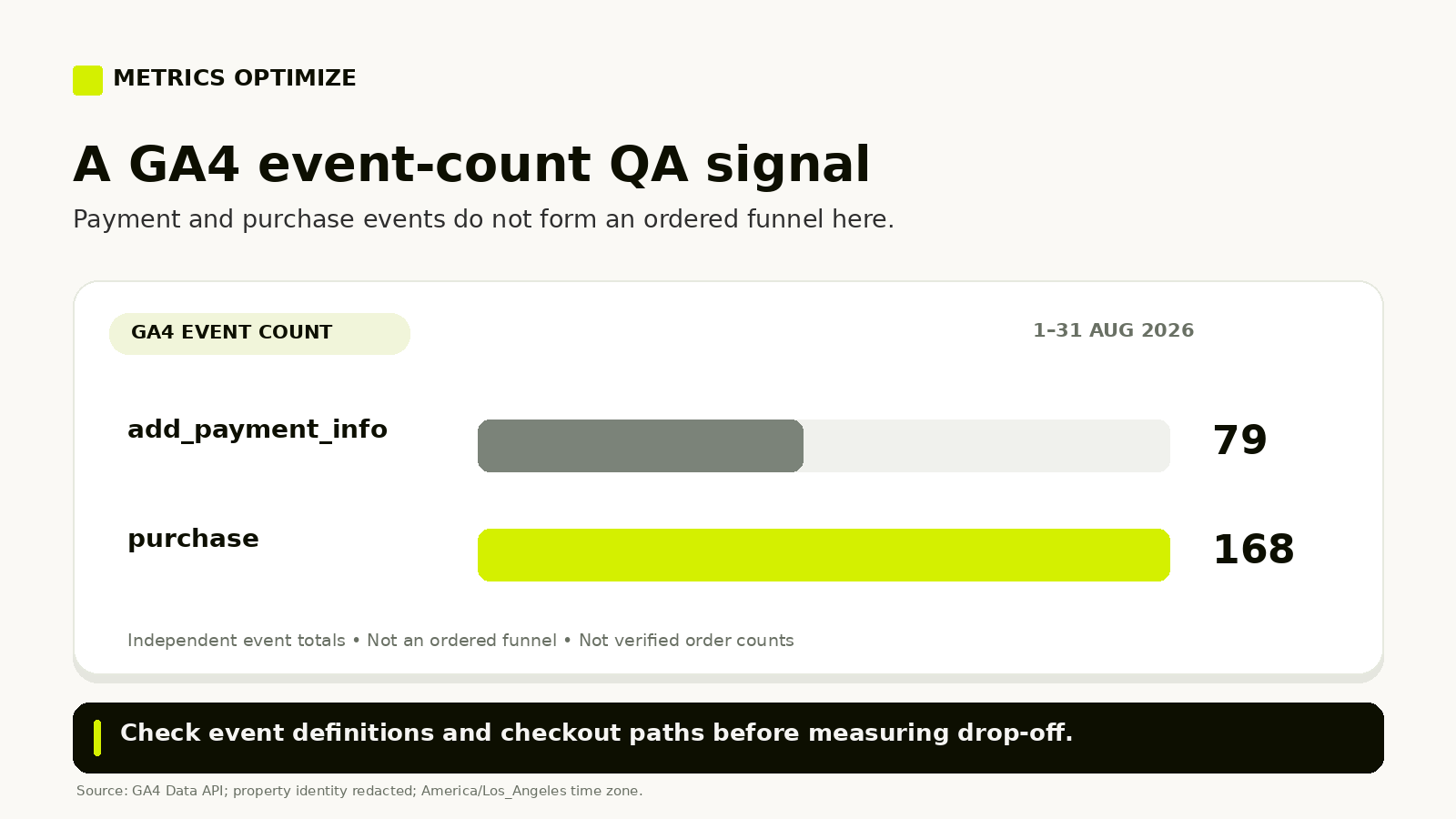
GA4 event counts, 1–31 August 2026. The chart is a measurement QA example from a separate property; it does not illustrate the zero-purchase audit above or compare GA4 with actual orders.
For ecommerce, Google Analytics documentation says a unique transaction_id deduplicates purchase events in web streams. That purchase-specific behaviour does not validate lead events or repair other duplicate firing. If the primary event is unreliable, fix the implementation, mark the affected period and rebuild the baseline before diagnosing page friction.
How Do You Calculate a Reliable CRO Baseline?
A reliable CRO baseline is a rate whose numerator and denominator describe the same eligible audience, unit and date range. For a user-based lead rate:
User conversion rate = unique eligible users with the defined lead event ÷ eligible users × 100.
In a hypothetical month, 80 of 4,000 eligible users submit a valid enquiry, so the user submission rate is 2.0%. If the CRM qualifies 32 of those enquiries, the qualified-lead rate per eligible user is 0.8%, subject to matching users and the qualification window correctly. Report the counts beside both percentages. A change of four leads carries a different level of uncertainty from a change of 400 leads.
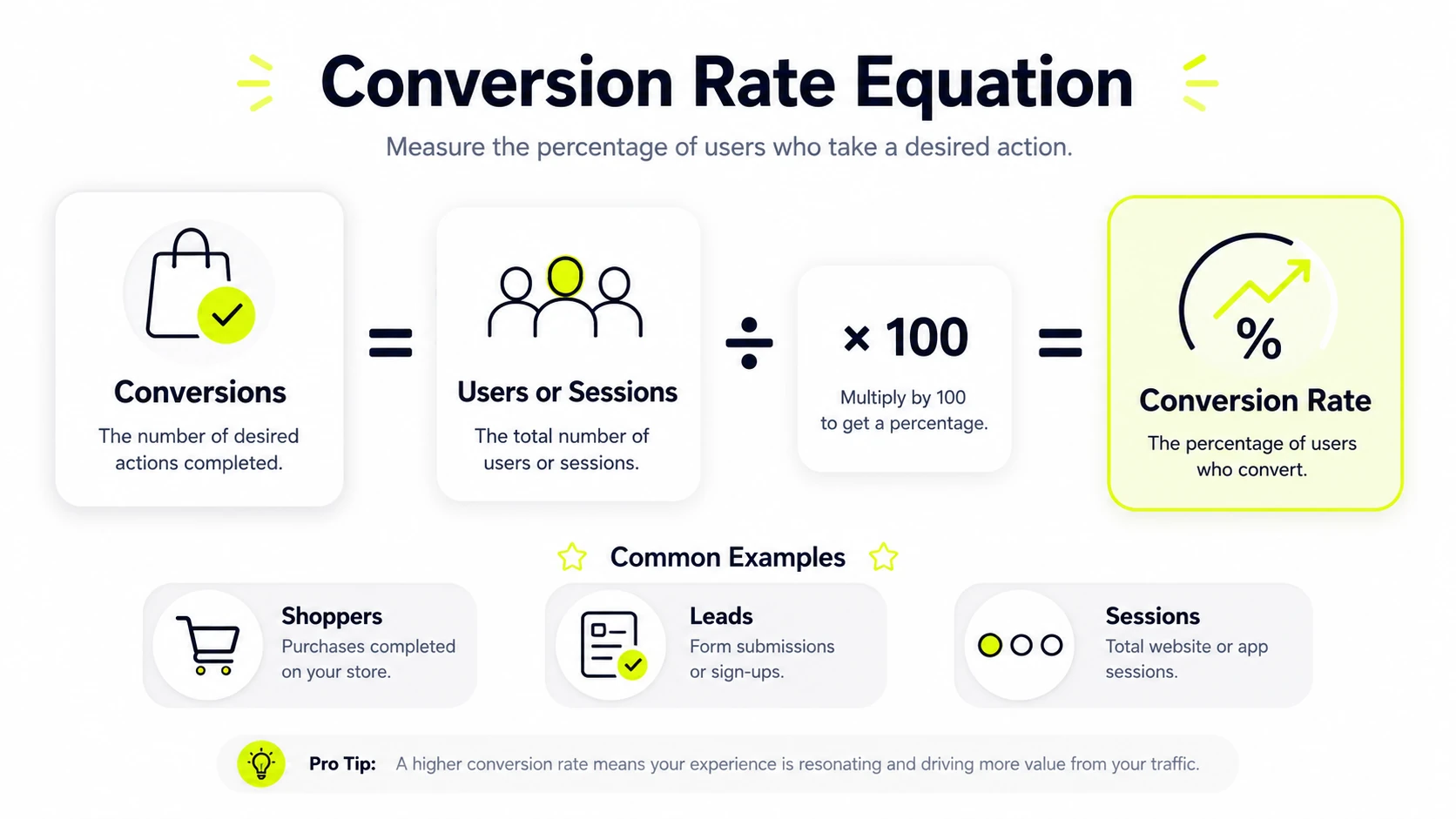
Record the metric's unit, the eligible pages and audiences, the comparison period, the GA4 event definition, the CRM or order source, and the absolute traffic and conversion counts. Include seasonality and the lag before a lead or sale is confirmed.
A session rate uses sessions with a key event divided by eligible sessions. A step completion rate uses completers divided by entrants to that step. Mixing a user numerator with a session denominator creates a different, misleading measure. A universal “good” conversion benchmark cannot replace a baseline for the same business and audience.
How Do You Map and Measure a Conversion Funnel?
Map the observable actions between an eligible entry and the chosen outcome, then calculate progression at each step. In GA4 Funnel exploration, step order matters: a user who misses a required step falls out of the defined sequence. Google Analytics distinguishes a closed funnel, which requires entry at the first step, from an open funnel that allows entry at a later step.
- Name the business journey and the eligible entry event.
- Assign one validated event or condition to each meaningful step.
- Choose an open or closed funnel based on how users actually enter the journey.
- Compare each step's entrants with users who reach the next required step.
- Break down a consequential loss by device, source or landing page after checking step instrumentation.
In one Metrics Optimize ecommerce implementation, product selection happened on WordPress while checkout ran on Shopify. The measurement map connected the Buy click and begin_checkout to add_shipping_info, add_payment_info and purchase, including the order ID. The cross-domain handoff made attribution continuity and event firing part of funnel validation.
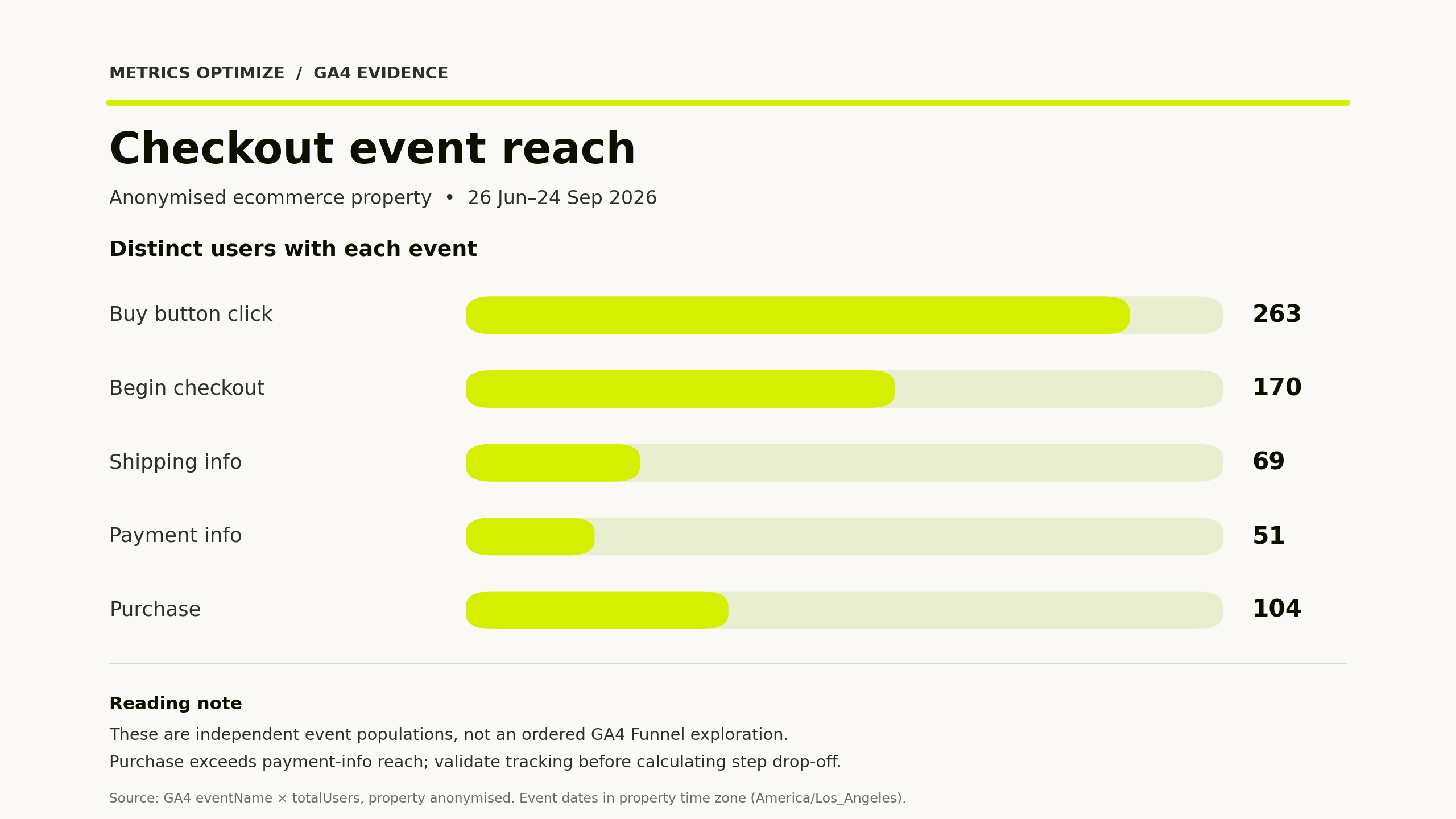
Real GA4 event reach, 26 June–24 September 2026. Each count is an independent event population, so this chart does not show step completion or drop-off. The hypothetical funnel below uses separate example figures.
The following counts are hypothetical and align with the lead generation example later in this article:
| Funnel step | Entrants | Reached next step | Abandoned | Abandonment rate |
|---|---|---|---|---|
| Service page view | 1,000 | 300 | 700 | 70% |
| Form start | 300 | 80 | 220 | 73.3% |
| Confirmed submission | 80 | Not applicable | Not applicable | Not applicable |
For each row, abandonment rate equals entrants minus users reaching the next step, divided by entrants. The first row's 70% does not by itself establish a defect: many visitors are not ready to enquire. A skipped or untracked step also changes the apparent loss. Prioritise the stage by eligible volume, downstream value and the quality of its instrumentation.
Which GA4 Segments Should a CRO Analysis Compare?
Compare GA4 segments that represent a plausible difference in intent or experience and retain the same conversion definition. GA4 segments can contain subsets of users, sessions or events; scope affects the population being compared. A device comparison is more useful when both groups share the same outcome, period and eligibility rules.
| Segment | Comparison | Diagnostic question | Caveat |
|---|---|---|---|
| Device and browser | Mobile versus desktop; one browser versus another | Is loss concentrated in a particular interface? | Check device mix and event firing |
| Source and channel | Paid search versus organic or referral | Does intent differ before the same step? | Keep attribution and landing context consistent |
| Landing page | Service page A versus page B | Does entry context change progression? | Page audiences can differ |
| New versus returning | First visit versus repeat visit | Does familiarity change the journey? | Identity and observation windows matter |
| Market or customer cohort | Relevant region or lead type | Is the business opportunity concentrated? | Small groups fluctuate more |
A Metrics Optimize ecommerce review also found a mobile and desktop purchase-rate gap. Because the journey crossed domains and channel attribution had anomalies, that gap was a signal to inspect device journeys and tracking before attributing it to mobile design.
Start with segments large enough to show both eligible traffic and conversions. Then inspect the absolute difference and its stability across adjacent periods. A low mobile completion rate suggests a focused check of mobile behaviour and tracking; it does not prove a mobile design flaw.
What GA4 Evidence Can Help Explain a Funnel Drop-Off?
GA4 explains the measured location, timing and audience of a funnel drop-off through event sequences, step counts and relevant breakdowns. The evidence becomes stronger when the same loss appears across comparable periods and a well-defined segment.
| Observation | Question to ask | Next validation |
|---|---|---|
| Mobile form starts rise while valid submissions fall | Did the form, audience or measurement change? | Test mobile validation, error events and backend records |
| One landing page has low form starts | Are visitors eligible and is the offer clear? | Compare channel intent and page-level behaviour |
| A step changes abruptly on one date | Was there a release, tag change or traffic shift? | Check deployment history and event QA |
| GA4 submissions differ from CRM leads | Is a success event firing without a valid record? | Reconcile timestamps and identifiers safely |
In that ecommerce channel review, paid search supplied substantial traffic while GA4 assigned much of the recorded revenue to Direct and the site's own referral. That pattern calls for a checkout-domain and source/medium audit before concluding that paid visitors had lower purchase value.
Google Analytics Funnel exploration counts users who complete specified steps in order and reports a user's first qualifying sequence within the date range. Those rules matter when interpreting repeats and skipped steps. Treat the GA4 pattern as an observation, list plausible explanations and test the instrumentation before assigning a cause.
What Microsoft Clarity Evidence Can Help Explain the Funnel Drop-Off?
Microsoft Clarity recordings and heatmaps can show repeated interaction patterns near a GA4 loss, such as dead clicks, rage clicks, repeated form attempts or a control placed below the typical scroll depth. Filter Clarity by the comparable page, device, date and available traffic criteria, then inspect both failed and successful journeys. The two tools need aligned definitions; a GA4 segment is not automatically a Clarity segment.
| Clarity signal | Plausible friction | Verification step |
|---|---|---|
| Repeated clicks on a nonresponsive element | A broken control or unclear feedback | Reproduce the interaction and inspect errors |
| Form field retries before exit | Validation or field requirement problem | Test the field and compare accepted submissions |
| Scroll maps show little exposure to the form | Placement or audience intent issue | Compare page layout by device and entry source |
| Back-and-forth navigation | Missing information or unclear next step | Inspect page path and ask users what they expected |
Clarity's own documentation describes filters for rage clicks, dead clicks, page paths, device and session actions. A recording is a selected session, not a count of every affected visitor; a heatmap summarises tracked interactions, not motivation. Save the observation, the affected population and an alternative explanation before writing a hypothesis.
How Do You Prioritize CRO Opportunities?
Prioritise a CRO opportunity by the number of eligible users exposed, the value of the outcome, the strength of evidence, implementation effort and measurement risk. A broken conversion event takes precedence when it prevents evaluation of any proposed change.
For example, a reproducible mobile form error affecting many qualified enquiry attempts deserves investigation and repair. A low-traffic footer link with no repeated user signal can wait. This is a decision aid, not a universal scoring formula. Estimate qualified conversions at stake using the baseline and exposure, then state the assumptions. A small but high-value journey can outrank a large group of low-intent visits. Revisit priorities when a tracking repair changes the observed baseline or when the CRM shows that raw lead volume does not translate into qualified opportunities.
How Do You Write a Measurable CRO Hypothesis?
A measurable CRO hypothesis names the affected audience, proposed change, expected outcome, supporting mechanism and evidence that would disprove the explanation. It specifies the measurement unit before implementation.
Template: If [change] is applied to [audience and step], then [primary metric] will [direction] because [observed mechanism]. The hypothesis is weakened if [specific predicted behaviour or outcome] does not appear.
Hypothetical example: If the mobile lead form displays validation feedback beside the affected field before submission, then valid submissions per eligible mobile form starter will increase because repeated failed attempts in Clarity coincide with a GA4 loss between form start and confirmed success. The proposed mechanism is weakened if controlled QA finds no field error, if the issue is confined to a tracking change or if the improved submission rate produces fewer CRM-qualified leads per eligible visitor.
Keep the primary metric, qualified-lead guardrail and proposed observation window in the test plan. A vague goal such as “improve the page” has no falsifiable prediction. The appropriate validation route depends on the available traffic and business risk.
When Is an A/B Test Feasible for a CRO Opportunity?
An A/B test is feasible when the eligible population can reach a prespecified sample for a meaningful effect within the decision window, the variants can be implemented consistently and the primary outcome can be measured. Plan the test before viewing its result.
Check the baseline event rate, eligible traffic per variant, practical minimum detectable effect, desired power, error threshold, allocation, run time and expected business risk. A smaller effect requires more observations than a large effect at the same baseline and power. Estimate duration from the required sample per variant and the expected eligible arrivals per day, then allow for the outcome's qualification lag. A calculator's estimate is a planning input, not a universal minimum traffic rule.
If the sample fits the decision window and measurement is stable, run the prespecified randomised test. If the sample is too large for the window, consider a larger meaningful change and recalculate. If the event is unreliable or traffic remains insufficient, repair tracking or gather stronger qualitative evidence first.
Predefine the primary metric, segments, guardrails, stopping rule and analysis method. Repeatedly checking a fixed-sample result and stopping only when it looks favorable changes the error rate.
What Can You Do When Traffic Is Too Low for an A/B Test?
Low traffic calls for evidence that improves the decision without pretending to establish an experiment result. Choose a focused route:
- Repair event quality and reconcile the outcome with CRM or orders.
- Review recordings and heatmaps for repeatable problems in the affected journey.
- Interview customers or run task-based usability sessions on the specific step.
- Combine genuinely comparable pages or periods only when the audience and intervention remain coherent.
- Evaluate a larger, business-relevant change when its risk is acceptable.
Pre/post movement and qualitative observations remain useful for diagnosis, but they provide weaker causal evidence than a well-run randomised test.
Which Guardrail Metrics Should Accompany a CRO Test?
Guardrail metrics detect a harmful trade-off while the primary conversion metric improves. Select measures tied to the outcome and decision window before launch.
| Primary outcome | Guardrail | Harm signal |
|---|---|---|
| More form submissions | CRM-qualified leads per eligible visitor | More submissions but fewer qualified leads |
| More purchases | Revenue per eligible visitor and refund rate | Higher order count with lower net value |
| More booked consultations | Attendance and opportunity rate | More bookings with more no-shows |
Record each guardrail's source, lag and threshold. An immature CRM outcome needs a longer observation window or an explicitly provisional decision.
What Does a Complete CRO Analysis Look Like in Practice?
A complete CRO analysis connects a validated business outcome to a specific observation, a plausible explanation and a test decision. The following lead generation case is hypothetical; its figures are examples, not Metrics Optimize client results.
A service business defines a qualified enquiry as a submitted form that receives an accepted CRM qualification status within 14 days. The analyst verifies that the GA4 generate_lead event fires after a successful backend response and reconciles test-excluded submissions with CRM records. For one month, 4,000 eligible users produce 80 valid submissions and 32 qualified leads: a 2.0% submission rate and 0.8% qualified-lead rate per eligible user.
A closed GA4 funnel shows 300 form starts and 80 confirmed submissions for the same eligible journey. Mobile starters have a larger loss at that step than comparable desktop starters. The analyst confirms that mobile events fire once and that the change is not explained by a new paid campaign. Clarity recordings filtered to the same page, mobile device and period show several repeat attempts at one field. A controlled mobile QA session reproduces a validation message that appears only after submission.
The validated GA4 funnel locates the loss; the recordings suggest a field-feedback mechanism; controlled QA identifies a reproducible defect. CRM qualification remains the guardrail because raw submissions alone do not measure lead quality.
Because QA reproduced the defect in this hypothetical case, the next action is to fix it and monitor the same baseline definition. If QA had not reproduced the issue and traffic supported a prespecified test, the analyst could compare an improved feedback variant with the current form. The decision follows measurement quality, the strength of the mechanism and test feasibility, not the size of the funnel drop alone.
Can a funnel drop-off prove its cause?
No. A funnel drop-off identifies a step where fewer eligible users progress; it does not reveal whether the cause is intent, a page problem, a technical fault or missing measurement. Check the event sequence and segment mix, then inspect session recordings for repeated behaviour. Reproduce suspected faults and seek user feedback or experimental evidence before assigning a cause. Describe the suspected cause as a hypothesis until evidence distinguishes it from alternatives.
Can duplicate GA4 events distort the baseline?
Yes. Duplicate event fires can inflate an event-count numerator or a funnel step and make a baseline look stronger than the underlying business records. Check triggers and parameters with a website event tracking QA process. Verify how the selected metric counts users, sessions and events before concluding that every rate is affected in the same way. GA4 uses transaction IDs to deduplicate web purchase events, but that purchase rule does not correct duplicate lead events.
Is the same denominator valid for every conversion rate?
No. A user rate divides converting users by eligible users, a session rate divides sessions with the event by eligible sessions and a funnel-step rate divides completers by entrants. The numerator must match the unit and eligibility of its denominator. Record the event, period and population whenever rates are compared, especially across GA4 reports and CRM outcomes. The digital analytics measurement framework explains how event records become counts, rates and business decisions.
Should a CRO test always use 95% confidence?
No. A 95% confidence convention is one possible decision threshold, not a rule for every business risk or statistical design. Choose the error threshold, power, minimum effect, analysis method and stopping plan before assigning variants. An expensive false positive and an expensive missed improvement call for different trade-offs. Do not reinterpret a repeatedly checked fixed-sample test as if its threshold had stayed unchanged.
Can a higher conversion rate reduce lead quality?
Yes. Removing qualifying questions from a form can increase submissions while lowering the share that becomes qualified CRM leads or sales opportunities. Compare qualified leads per eligible visitor and downstream value with the raw website rate. A higher form completion percentage is a poor decision signal when the extra enquiries add screening cost without business value.
Does a low-traffic page still justify CRO analysis?
Yes. A low-traffic page can justify CRO analysis when each qualified conversion has substantial value or the page is essential to a wider journey. Validate tracking, examine observed friction and speak with relevant users before changing it. Small rate movements remain uncertain, and an unrandomised before/after comparison does not isolate the effect of a change. The analysis still ends with an explicit decision and evidence limit.

Written by
Zunnun Ahmed
Digital analytics consultant helping businesses make data-driven decisions. Specializing in GA4, GTM, conversion tracking, and marketing attribution to turn messy data into profitable growth strategies. Semantic SEO expert in the Koray Tuğberk Gübür methodology.